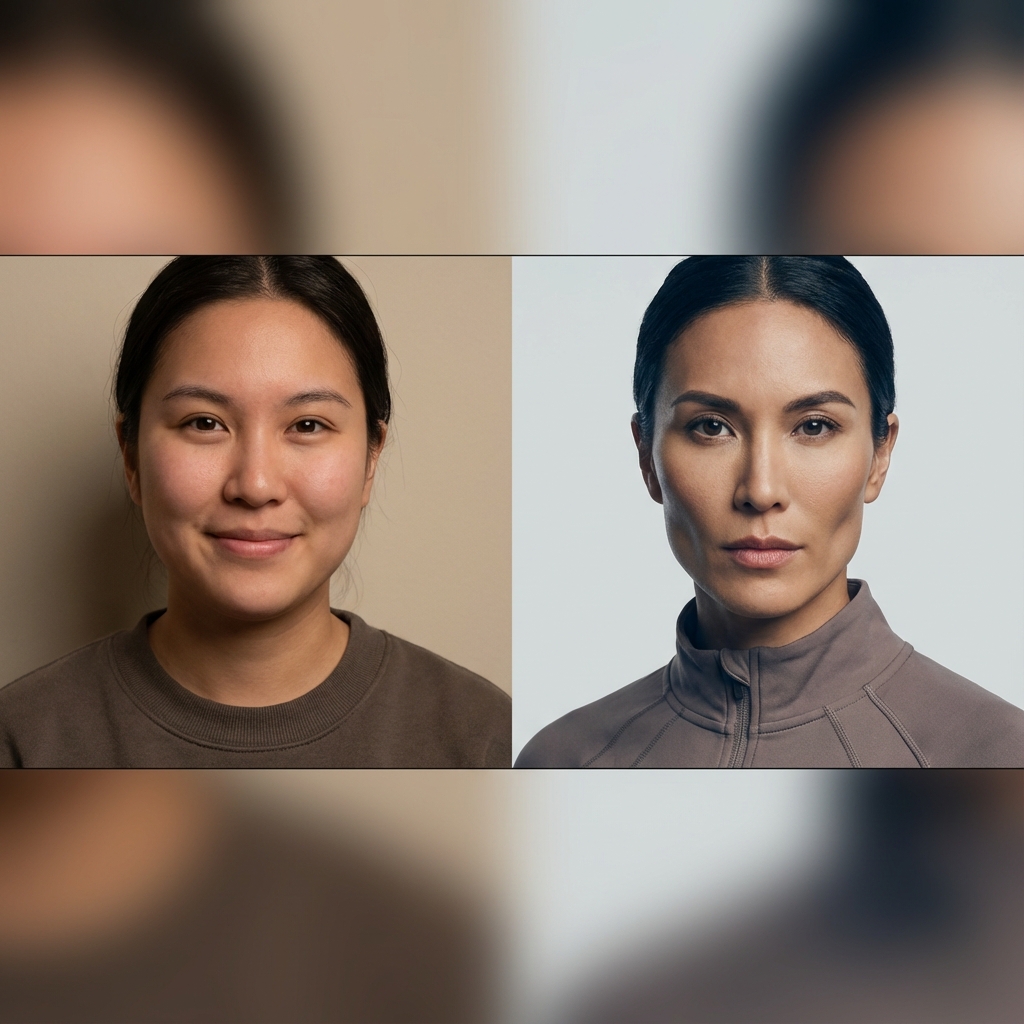
You've likely noticed it in photos: a few extra pounds can turn a chiseled jawline into a soft curve, while weight loss often reveals hidden cheekbones. But does weight actually change your underlying face shape structure? The answer is a complex mix of biology, anatomy, and visual perception.
The Truth About Facial Structure vs. Soft Tissue
Key Takeaway
Your skeletal face shape (bone structure) remains constant throughout adulthood. However, the perceived face shape changes dramatically with the fluctuation of subcutaneous fat, muscle mass, and water retention.
To understand how weight affects your look, we must distinguish between your skull's geometry and the soft tissue that overlays it. Your skull defines whether you are fundamentally a Square, Oval, or Heart shape. This bone structure doesn't shift when you gain or lose 10 pounds. What changes is the volume of the "padding" on top of that frame.
How Fat Distribution Masks Your True Shape
When we gain weight, the body stores fat in specific "depots" around the face. These storage areas can camouflage your natural angles, leading to a confusion of face shapes.
- The Jawline: Submental fat (under the chin) and jowls can hide a sharp square or diamond jawline, making the lower face look rounder.
- The Cheeks: The buccal fat pads fill out the mid-face. An increase here turns the tapered look of a Heart shape into a Round shape.
- The Neck: A wider neck visual base can lessen the impact of a strong jaw, softening the overall silhouette.
Weight Gain vs. Weight Loss: The Visual Impact
The transformation can be striking. Let's break down exactly how different weight directions alter specific facial zones.
| Facial Zone | Effect of Weight Gain | Effect of Weight Loss |
|---|---|---|
| Cheekbones | Buried under soft tissue; face looks wider and flatter. | Become prominent; creates shadows (contour effect). |
| Jawline | Softens; definition is lost to jowls or double chin. | Reveals the mandible bone; angles become sharp. |
| Eyes | Can appear smaller due to puffy surrounding tissue. | Appear larger and more alert as puffiness subsides. |
| Overall Shape | Tends towards Round or Pear. | Reveals the true Square, Diamond, or Oval. |
The "Ozone" Layer of the Face: Why Some People Store Fat Differently
You might have a friend who gains weight but keeps a thin face, while another person sees weight gain immediately in their cheeks. This is genetic.
High Facial Fat Storage
Some individuals are genetically predisposed to store visceral and subcutaneous fat in the facial region first. For these people, even minor weight fluctuations dramatically alter their perceived face shape.
Low Facial Fat Storage
Others maintain a "lean face" regardless of body BMI. Their bone structure remains the dominant visual feature, meaning their face shape diagnosis is consistent even with weight changes.
Identifying Your "True" Face Shape
If you are currently carrying extra weight, it can be difficult to correctly identify your face shape using standard charts. A Round face might actually be a Square face with "softened corners."
This is where advanced analysis comes in. Manual measurement can be tricky when landmarks are obscured.
Tips for True Identification:
- Feel the Bone: Don't just look in the mirror. Use your fingers to trace your jawline bone from the ear to the chin. Where does it angle? That is your true shape.
- Check Old Photos: Look at photos of yourself at a lower weight to see the underlying architecture.
- Use AI Technology: Our Face Shape Detector uses computer vision to estimate landmarks even when they are partially obscured, giving you a more accurate structural analysis than a simple mirror check.
Curious About Your Underlying Structure?
Our AI scans deeper than the surface to predict your true face shape geometry.
Analyze My Face Shape FreeConclusion: Embrace Your Evolution
Your face is dynamic. It tells the story of your life, your health, and your genetics. Whether you are in a phase of softness or definition, understanding the mechanics of how weight affects your appearance allows you to style yourself with confidence.
Don't get hung up on a label that might be temporary. Focus on health, and let your natural structure shine through. And if you're ever in doubt, technology is here to give you an objective second opinion.